What Is Endoscopic Spine Surgery? A Simple Guide for Patients With Sciatica and Disc Problems
Medicine Made Simple Summary
Endoscopic spine surgery is a modern minimally invasive procedure used to treat certain spine problems such as slipped discs, sciatica, and nerve compression. In this technique, surgeons use a thin tube with a tiny camera called an endoscope to see inside the spine and remove the part of the disc or tissue that is pressing on a nerve. The surgery is performed through very small incisions in the skin, which helps reduce damage to muscles and surrounding tissues. This often allows patients to recover faster, experience less pain after surgery, and return to normal activities sooner compared with traditional spine surgery.
Understanding the Basics of Spine Problems
Back pain is one of the most common health complaints worldwide. Many people experience occasional discomfort in their lower back or neck due to muscle strain, poor posture, or long hours of sitting.
However, in some cases the pain is caused by a deeper problem within the spine. Conditions such as slipped discs, spinal stenosis, or nerve compression can lead to persistent pain that may travel to the legs or arms.
When these conditions occur, they can affect the nerves that connect the spine to different parts of the body. This nerve irritation can cause symptoms such as shooting pain, numbness, tingling, or weakness.
While many spine problems improve with rest, medication, and physiotherapy, some cases require medical procedures to relieve pressure on the affected nerves.
Endoscopic spine surgery is one of the newer techniques used to treat certain spine conditions with minimal disruption to surrounding tissues.
Suggested Image: Diagram showing structure of the human spine with vertebrae and discs.
What Happens in Conditions Like a Slipped Disc or Sciatica
To understand how endoscopic spine surgery works, it helps to understand how spine problems develop.
The spine is made up of bones called vertebrae. Between these bones are soft cushions called intervertebral discs. These discs act as shock absorbers and allow the spine to bend and move.
Sometimes a disc may bulge or rupture. When this happens, the disc may press against nearby nerves.
This pressure on the nerve can cause symptoms such as back pain or pain that travels down the leg. This type of nerve pain is often referred to as sciatica.
In some patients, the opening through which nerves pass may become narrowed. This condition is called spinal stenosis and can also lead to nerve compression.
When these problems do not improve with conservative treatments, surgery may be considered to relieve the pressure on the nerves.
Suggested Image: Illustration of herniated disc pressing on a spinal nerve.
What Makes Endoscopic Spine Surgery Different
Traditional spine surgery usually requires a larger incision and separation of muscles to reach the spine. Although this approach can be effective, it may involve longer recovery time and greater disruption to surrounding tissues.
Endoscopic spine surgery uses a different approach, and many patients research endoscopic spine surgery vs traditional spine surgery to understand these differences.
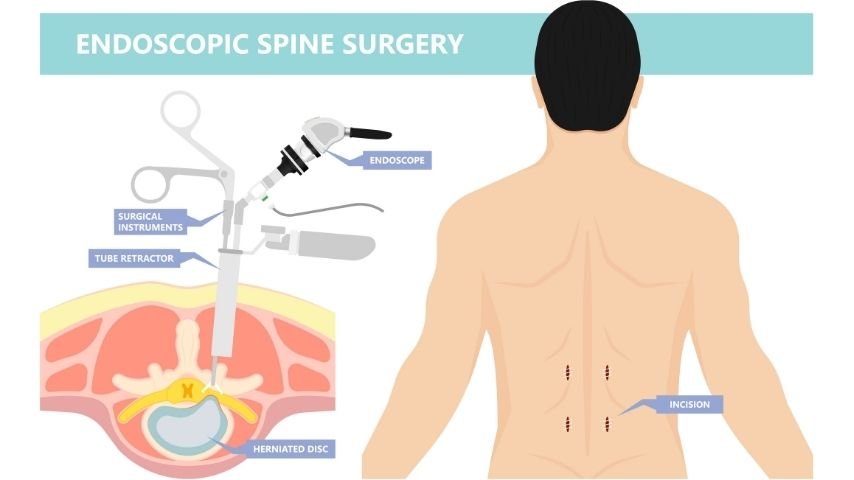
Instead of making a large incision, surgeons make a very small opening in the skin, usually less than one centimeter. Through this opening, a thin tube called an endoscope is inserted.
The endoscope contains a tiny camera and light that allow the surgeon to see inside the spine on a high-definition monitor.
Specialized surgical instruments are then used through this small tube to remove the tissue or disc material that is pressing on the nerve.
Because the procedure involves minimal muscle disruption, patients often experience faster recovery compared with traditional surgery.
Suggested Image: Diagram showing endoscope inserted into spine through a small incision.
Conditions That May Be Treated With Endoscopic Spine Surgery
Endoscopic spine surgery is commonly used to treat specific types of spine problems that involve nerve compression.
One of the most common conditions treated with this technique is a herniated or slipped disc. In this condition, part of the disc presses on a nerve and causes pain.
Another condition is spinal stenosis, where the space within the spine becomes narrow and compresses nerves.
Some patients with persistent sciatica caused by disc herniation may also benefit from endoscopic spine surgery.
This procedure may also be used for certain cases of degenerative disc disease or nerve root compression.
However, not every spine condition can be treated with this technique. Doctors carefully evaluate each patient before recommending surgery.
Suggested Image: Graphic showing different spinal conditions such as disc herniation and stenosis.
How Doctors Decide If Surgery Is Needed
Doctors usually begin treatment for spine problems with conservative methods.
These may include rest, anti-inflammatory medications, physiotherapy, and exercises that strengthen the back muscles.
Many patients improve with these treatments within a few weeks or months.
However, surgery may be considered when symptoms persist despite treatment. Severe nerve pain, progressive weakness, or significant limitations in daily activities may indicate the need for surgical intervention.
Doctors may recommend imaging tests such as MRI scans to examine the spine and identify the exact location of nerve compression.
These scans help determine whether endoscopic spine surgery may be appropriate.
Suggested Image: MRI scan illustration showing disc herniation.
How the Endoscopic Spine Surgery Procedure Works
On the day of the procedure, the patient is usually given anesthesia so they remain comfortable during surgery.
The surgeon makes a small incision near the affected part of the spine.
A thin tube is inserted through the incision, and the endoscope is guided toward the area where the nerve is compressed.
The camera at the tip of the endoscope allows the surgeon to view the spine clearly on a monitor.
Using specialized instruments, the surgeon removes the portion of the disc or tissue that is pressing on the nerve as part of the endoscopic spine surgery procedure.
Once the nerve is decompressed, the instruments are removed and the small incision is closed.
Because the incision is very small, stitches may be minimal and the procedure typically results in less blood loss compared with open surgery.
Suggested Image: Step-by-step diagram of endoscopic spine surgery.
Recovery After Endoscopic Spine Surgery
One of the major advantages of endoscopic spine surgery is the potential for faster recovery.
Many patients are able to walk within hours after the procedure. Some patients may even return home on the same day or the following day depending on their condition.
Pain after surgery is usually less compared with traditional open spine surgery because the muscles and tissues around the spine are minimally disturbed.
Patients are usually advised to gradually resume normal activities over the following weeks, and doctors often discuss the expected endoscopic spine surgery recovery time during follow-up consultations.
Physical therapy and specific exercises may be recommended to strengthen the back and prevent future spine problems.
Suggested Image: Illustration showing patient walking during recovery after spine surgery.
Benefits of Endoscopic Spine Surgery
Endoscopic spine surgery offers several advantages for suitable patients.
The procedure requires a very small incision, which results in less damage to muscles and tissues.
Patients often experience less postoperative pain and shorter hospital stays.
Because recovery tends to be faster, many individuals can return to daily activities sooner than with traditional surgery.
The use of high-definition cameras also allows surgeons to perform the procedure with great precision.
However, the success of the surgery depends on proper patient selection and the expertise of the surgical team.
Possible Risks and Limitations
Like all surgical procedures, endoscopic spine surgery carries certain risks.
Although complications are uncommon, they may include infection, bleeding, or persistent nerve irritation.
In some cases, symptoms may not improve completely or may return later if the underlying spine condition progresses.
For this reason, surgeons carefully evaluate each patient before recommending the procedure.
Understanding both the benefits and limitations helps patients make informed decisions about treatment.
Why Early Diagnosis Matters
Many spine conditions can be treated successfully if diagnosed early.
Ignoring persistent back pain or nerve symptoms may allow the condition to worsen over time.
Seeking medical advice when symptoms continue or affect daily life can help doctors identify the cause and recommend appropriate treatment.
For some patients, minimally invasive procedures such as endoscopic spine surgery may provide effective relief with faster recovery.
Conclusion
If you are experiencing persistent back pain, leg pain, or symptoms of sciatica that do not improve with rest or physiotherapy, consulting a spine specialist can help determine the cause. Early evaluation allows doctors to identify whether minimally invasive treatments such as endoscopic spine surgery may help relieve nerve compression and restore normal movement.
References and Sources