Laser Fistula Surgery vs Seton: Which Treatment Is Better When the Fistula Involves the Sphincter?
Medicine Made Simple Summary
When an anal fistula passes through or close to the sphincter muscles, treatment becomes more complicated because the surgeon must close the fistula while protecting bowel control. A seton is a thin surgical thread placed through the fistula to keep it draining and, in many cases, control infection before further treatment. FiLaC, or fistula-tract laser closure, is a sphincter-preserving procedure that uses laser energy to treat the fistula tunnel without deliberately cutting the sphincter. Neither treatment is automatically better for everyone. The choice depends on fistula anatomy, complexity, previous treatment and individual patient factors.
Why Does the Sphincter Matter in an Anal Fistula?
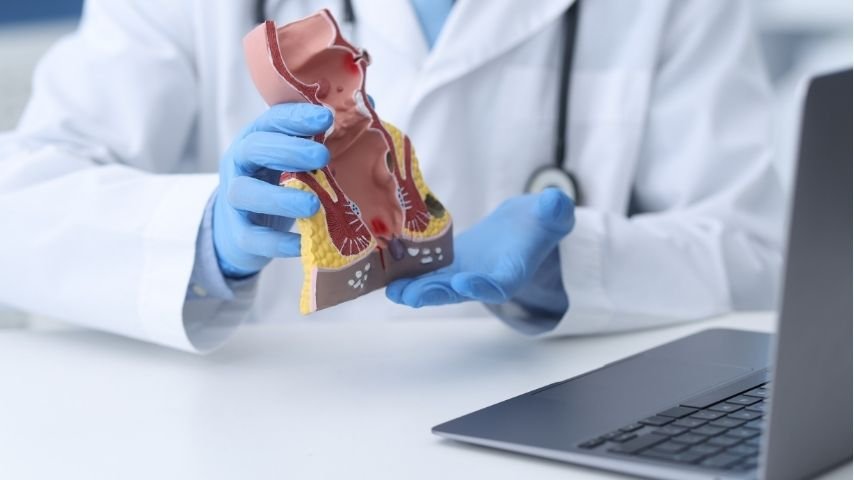
An anal fistula is an abnormal tunnel connecting the anal canal to the skin around the anus. It often develops after an anal abscess drains but leaves a tract behind.
For a simple fistula, treatment can sometimes be relatively straightforward.
But some fistulas pass through the muscles that control bowel movements. These are called the anal sphincter muscles.
These muscles are extremely important. They help you control when you pass stool and gas.
This creates a difficult balance for the surgeon.
The fistula needs to be treated completely.
At the same time, unnecessary damage to the sphincter needs to be avoided.
This is why patients with sphincter-involving fistulas may be offered procedures such as a seton or FiLaC laser fistula surgery, rather than a straightforward fistulotomy.
The American Society of Colon and Rectal Surgeons recommends considering the relationship between the fistula and sphincter when selecting treatment because cutting through too much sphincter can increase the risk of continence problems.
What Is a Seton?
A seton is a thin surgical material placed through the fistula tract.
It may look unusual when you first see it. It can appear as a small loop passing through the opening near the anus.
But the purpose is quite practical.
The seton keeps the fistula pathway open so that pus and other fluid can continue to drain instead of becoming trapped.
This can help control infection and prevent another abscess from developing while the surgeon plans the next stage of treatment.
A seton is particularly useful when the fistula involves a significant amount of sphincter muscle.
In many cases, it is not intended to be the final treatment.
Instead, it can be part of a staged approach.
The American Society of Colon and Rectal Surgeons describes the use of a draining seton for complex fistulas to control local infection before a definitive procedure is performed.
Does Having a Seton Mean My Fistula Is Not Being Treated?
No.
This is a common misunderstanding.
A seton may be an important part of the treatment plan.
Think of it as a way of controlling the fistula before attempting to close it permanently.
The seton allows continuous drainage.
This can reduce the chance of fluid becoming trapped and forming another abscess.
Depending on the fistula, the seton may remain for several weeks or longer.
Your surgeon may then recommend another procedure once the infection and inflammation have settled.
In some patients, the seton itself may be part of longer-term management.
The exact plan depends on the type of seton and the fistula anatomy.
What Is FiLaC Laser Fistula Surgery?
FiLaC stands for Fistula-tract Laser Closure.
It is a minimally invasive, sphincter-preserving technique developed to treat selected anal fistulas.
The basic concept is easier to understand than the name suggests.
A thin laser fibre is placed inside the fistula tunnel.
Laser energy is then delivered along the tract.
The aim is to destroy or shrink the abnormal fistula lining and encourage the tunnel to close.
The major attraction of FiLaC is that it is designed to treat the fistula without deliberately cutting through the anal sphincter.
This makes it particularly interesting when preservation of bowel control is a major concern.
However, FiLaC is not a universal solution.
The fistula must first be assessed to determine whether laser treatment is appropriate.
Published studies describe FiLaC as a sphincter-preserving technique, but healing rates vary considerably between studies and long-term comparative evidence remains limited.
How Is FiLaC Different From a Seton?
The simplest difference is their purpose.
- A seton primarily helps control drainage and infection.
- FiLaC aims to close the fistula tract.
- A seton therefore may be used as an initial or staged treatment.
- FiLaC is generally considered a definitive sphincter-preserving procedure for selected fistulas.
This means they are not necessarily competing treatments.
In some patients, a seton may actually be used before FiLaC.
In a 10-year study of 175 patients treated with FiLaC, 81.8% had a seton or draining loop placed before laser treatment. The researchers reported a higher primary healing rate among patients who had undergone prior drainage with a seton compared with those who had not.
Therefore, the question is not always “Seton or laser?”
Sometimes the treatment pathway can involve seton followed by laser.
When Is a Seton Usually Considered?
A seton may be considered when a fistula is complex or passes through important sphincter muscle.
It can be particularly useful when there is ongoing infection or an abscess that needs to be controlled.
The seton provides a drainage route.
This can allow inflammation to settle before another procedure is performed.
For example, a patient may first undergo drainage of an abscess.
A seton may then be placed through the fistula.
After the infection is controlled, the surgeon may reassess the tract and choose a definitive procedure.
This staged approach can be safer than trying to treat everything in one operation.
The ASCRS guidelines describe draining seton placement followed by a definitive procedure as a common approach for complex fistulas.
When Might FiLaC Be Considered?
FiLaC may be considered when preserving the sphincter is important and the fistula anatomy is suitable.
It has been studied particularly in transsphincteric and recurrent fistulas, where a traditional fistulotomy may carry a greater risk of sphincter injury.
In one long-term study, most patients treated with FiLaC had transsphincteric fistulas, and many had previously undergone seton drainage or other procedures. The study reported a primary healing rate of 66.8% after a median follow-up of five years.
However, results are not always this high.
A 2025 systematic review involving 24 studies and 1,503 patients reported a pooled primary healing rate of 57.46% and recurrence in about 18.5% of patients. New-onset incontinence was uncommon in the pooled data.
This tells us something important.
FiLaC can be a useful sphincter-preserving option, but it should not be presented as a guaranteed cure.
Is FiLaC Better Because It Is a Laser Procedure?
Not necessarily.
The word “laser” can make a treatment sound automatically more advanced or effective.
But the technology itself does not determine whether it is the right treatment.
The anatomy of the fistula is more important.
A fistula may have multiple branches.
The internal opening may be difficult to identify.
There may be an abscess.
There may be significant scarring from previous surgery.
The fistula may pass through different portions of the sphincter.
All of these factors can influence the outcome.
The 2025 systematic review found that FiLaC has an intermediate healing rate and concluded that more high-quality trials are needed to determine its role compared with other treatments.
So, laser should be viewed as one treatment option, not automatically as the best treatment.
What Are the Advantages of a Seton?
One of the biggest advantages of a draining seton is that it provides continuous drainage.
This is particularly useful when there is infection or a complex fistula.
It can help prevent an abscess from repeatedly forming.
It also gives the surgeon time to understand the fistula and plan the next stage.
For some patients, this staged approach can reduce the need to make an immediate decision about cutting through sphincter muscle.
However, a seton can be inconvenient.
You may experience ongoing drainage.
The surrounding skin can become irritated.
You may need to use gauze or a small pad.
You may also need more than one procedure.
The seton therefore solves one part of the problem while potentially requiring another stage of treatment.
What Are the Advantages of FiLaC?
The main attraction of FiLaC is sphincter preservation.
The laser is delivered inside the fistula tract rather than cutting through the sphincter.
This can make it an attractive option for patients concerned about bowel control.
FiLaC is also minimally invasive compared with procedures that require opening the entire fistula tract.
Earlier systematic reviews have reported relatively low complication rates and low rates of continence problems. A 2020 review of 454 patients reported a weighted mean primary healing rate of 67.3% and continence affection of about 1%, although the authors emphasised the need for better comparative trials.
More recent evidence is somewhat more cautious, with lower pooled healing rates reported across a larger body of literature.
This difference highlights why patients should ask about the surgeon's experience and their own specific fistula rather than relying on a single success-rate number.
What Are the Limitations of FiLaC?
The biggest limitation is that it does not guarantee permanent closure.
Some fistulas heal.
Some recur.
Some require another procedure.
The 2025 meta-analysis reported a reoperation rate of about 36.5% after laser-based fistula treatment.
This does not mean that every patient has a one-in-three chance of needing another operation.
The number comes from pooled studies involving different patients, techniques and follow-up periods.
Your individual risk can be different.
The surgeon should explain the expected likelihood of healing and recurrence for your particular fistula.
What Are the Limitations of a Seton?
A seton may not eliminate the fistula by itself.
A draining seton is often used to control infection and maintain drainage rather than permanently close the fistula.
This means you may need another procedure later.
You may also experience ongoing discharge while the seton is in place.
There are different types of setons.
- A loose or draining seton is designed primarily to maintain drainage.
- A cutting seton gradually divides tissue and is a different approach.
These should not be confused.
Cutting setons can carry a risk of continence problems because they intentionally divide tissue involving the sphincter. Current guidelines therefore recommend selective use rather than treating them as the default option for complex fistulas.
Which Is Better for Fistulas Involving the Sphincter?
There is no universal winner.
A seton may be better when the immediate priority is controlling infection and maintaining drainage.
FiLaC may be considered when the fistula is suitable for laser closure and the goal is definitive treatment while preserving the sphincter.
In some patients, the two may actually be used together.
A seton can first control the infection.
The fistula can then be treated with FiLaC.
The long-term study of FiLaC provides an example of this approach, with more than 80% of patients having prior seton or draining-loop placement.
Therefore, treatment should be planned around the patient's anatomy rather than around the name of a procedure.
What About Other Sphincter-Preserving Procedures?
FiLaC and setons are not the only options.
Depending on the fistula, your surgeon may consider procedures such as LIFT, which stands for ligation of the intersphincteric fistula tract.
An advancement flap is another option.
VAAFT, or video-assisted anal fistula treatment, may also be considered in selected patients.
These procedures have different techniques and different evidence.
A 2025 network meta-analysis comparing sphincter-sparing approaches found variable failure rates across LIFT, VAAFT, FiLaC and endoanal flap procedures, reinforcing that no single technique can be considered universally superior.
This is why a specialist should assess the fistula before recommending treatment.
What Should You Ask Your Surgeon?
Before choosing between a seton, FiLaC or another procedure, ask where exactly the fistula passes.
Ask whether it involves the sphincter.
Ask whether it is simple or complex.
Ask whether there are multiple branches.
Ask whether an MRI is required.
If a seton is recommended, ask whether it is temporary or intended for longer-term management.
If FiLaC is recommended, ask why it is appropriate for your particular fistula.
Ask about the surgeon's experience with the procedure.
Ask about expected healing and recurrence rates in patients with fistulas similar to yours.
Most importantly, ask what happens if the first procedure does not completely heal the fistula.
These questions help you understand the treatment plan rather than choosing based only on the procedure's name.
The Key Takeaway
When an anal fistula involves the sphincter, treatment becomes a balance between closing the fistula and protecting bowel control.
A seton and FiLaC solve different parts of this problem.
A seton keeps the fistula draining and can control infection, often as part of a staged treatment plan.
FiLaC uses laser energy to treat the fistula tract while aiming to preserve the sphincter.
Neither is automatically better.
Some patients may benefit from a seton first and FiLaC later.
Others may be better suited to LIFT, an advancement flap, fistulotomy or another procedure.
The anatomy of the fistula determines the safest approach.
Conclusion
If you have been told that your anal fistula involves the sphincter, it is understandable to worry about surgery and bowel control.
The good news is that modern treatment does not always require cutting through the sphincter.
A seton can provide drainage and help control infection while protecting the muscle.
FiLaC offers another sphincter-preserving option by using laser energy inside the fistula tract.
But neither treatment should be viewed as a guaranteed solution.
The available evidence shows that FiLaC can achieve healing in many patients, but recurrence and the need for further treatment remain possible. Recent research also shows considerable variation in outcomes between studies.
The right decision depends on the fistula's pathway, whether it has branches, the amount of sphincter involved, previous procedures and your overall health.
In some cases, the best treatment may not be either seton or laser alone.
A seton may first be used to control infection, followed by a definitive sphincter-preserving procedure.
If you are considering FiLaC, ask your surgeon why it is appropriate for your fistula and what the alternatives are.
The most important goal is not simply to choose the newest procedure.
It is to treat the fistula effectively while protecting the function of the sphincter.
References and Sources
PubMed – Could FiLaC Be Effective in the Treatment of Anal Fistulas?
PubMed – A Systematic Review and Meta-analysis of the Safety and Efficacy of Fistula Laser Closure
PubMed – Treatment of Anal Fistula With FiLaC: Results of a 10-Year Experience With 175 Patients