Is That Lump Really a Hernia? 7 Signs You Shouldn’t Ignore
Medicine Made Simple Summary
A hernia happens when an organ, tissue or fat pushes through a weak area in the muscle wall that normally holds it in place. A lump or bulge is one of the most common signs, but a hernia can also cause pain, heaviness, burning or discomfort, especially when coughing, lifting or standing. Some hernias cause very few symptoms. Others can become trapped and lose their blood supply, creating a medical emergency. Understanding the warning signs can help you recognise a possible hernia and know when to seek medical attention.
Understanding What a Hernia Really Is
Imagine the muscles of your abdomen as a strong protective wall. This wall helps keep the organs inside your abdomen in their normal position. If part of this wall becomes weak or develops an opening, tissue from inside the abdomen can push through it.
This is called a hernia.
The tissue pushing through may be fatty tissue or part of the intestine. The result can be a visible or noticeable lump under the skin.
Hernias can occur in different parts of the body. An inguinal hernia develops in the groin. An umbilical hernia develops around the belly button. An incisional hernia can develop at the site of a previous abdominal surgery.
Not every hernia looks the same.
Some appear as an obvious lump. Others may be small and difficult to notice. Some become visible only when you stand, cough or strain. Some cause pain, while others may cause little or no discomfort.
This is why noticing a new lump should not automatically make you panic. But it should also not be ignored.
Why Does a Hernia Happen?
A hernia usually develops because of two things.
There is a weak area in the muscle or connective tissue. There is also pressure inside the abdomen that pushes tissue towards that weak area.
The weakness may be present from birth. It can also develop over time.
Increased pressure inside the abdomen can occur because of repeated heavy lifting, chronic coughing, constipation and repeated straining. Pregnancy and excess body weight can also increase pressure on the abdominal wall. Previous abdominal surgery can create a weak area where an incisional hernia may later develop.
Age can also play a role because muscles and connective tissues can become weaker over time.
However, a hernia does not always have one obvious cause.
You may develop one even if you have never lifted something particularly heavy.
The important point is that a hernia is caused by a weakness in the body wall that allows tissue to push through.
So, Is Every Lump a Hernia?
No.
This is one of the most important things to understand.
A lump under the skin can have several causes. It could be a hernia, but it could also be related to other conditions involving the skin, fat, muscles or lymph nodes.
This means you should not try to diagnose the lump yourself.
Doctors usually diagnose a hernia by asking about your symptoms and examining the area. In some cases, an ultrasound, CT scan or MRI may be needed if the diagnosis is unclear.
So, if you have noticed a new lump in your abdomen, belly button, groin or near an old surgical scar, getting it examined is the safest first step.
Seven Signs That a Lump Could Be a Hernia
- You Notice a New Lump or Bulge
The most recognisable sign of a hernia is a lump or bulge.
Depending on where the hernia occurs, the bulge may appear in the groin, lower abdomen, belly button, upper thigh or at the site of previous surgery.
The lump may be small at first. It can gradually become more noticeable.
Some people notice it while getting dressed. Others notice it while showering or looking in the mirror.
The bulge may also appear and disappear.
For example, it may be more visible when you are standing and become smaller when you lie down. This can happen because the tissue moves back through the opening when the pressure inside the abdomen decreases.
A disappearing lump should not necessarily be considered harmless.
If the lump keeps returning, it is worth getting it checked.
Suggested image: Illustration showing a visible groin hernia and an umbilical hernia, with labels showing common locations.
- The Lump Becomes More Noticeable When You Cough, Sneeze or Strain
Have you noticed a lump that becomes more obvious when you cough?
This can be an important clue.
Coughing, sneezing, lifting and straining temporarily increase pressure inside the abdomen.
If there is a weak area in the abdominal wall, tissue can push through that area. The bulge may therefore become more prominent when you cough or strain.
Doctors may actually ask you to stand and cough during a physical examination.
This helps them identify a bulge that may not be obvious when you are lying down.
A lump that changes with coughing or straining does not prove that you have a hernia. But it is a good reason to have the area examined.
- You Feel Pain, Pressure, Burning or Heaviness
A hernia does not always cause pain.
Some people have a hernia for a long time without significant discomfort.
Others experience an aching, burning, pulling or heavy sensation.
You may feel discomfort while lifting something. It may also become more noticeable when you bend, cough or stand for a long period.
An inguinal hernia may cause discomfort in the groin. In some men, the swelling can extend towards the scrotum and cause discomfort there.
The intensity of symptoms can vary.
A small hernia can sometimes be uncomfortable, while a larger hernia may cause surprisingly little pain.
This is why the amount of pain does not always tell you how serious the hernia is.
If discomfort is new, persistent or getting worse, speak with a doctor.
- The Lump Is Getting Bigger
A hernia can start as a very small bulge.
Over time, some hernias become larger.
You may notice that the lump is more obvious than it was several months ago. You may also find that certain activities cause more discomfort than before.
A growing hernia should not simply be ignored because it is not painful.
Pain is not the only reason to seek medical advice.
The doctor will consider the location and size of the hernia, your symptoms and your overall health. They can then explain whether monitoring or surgical repair may be appropriate.
In general, hernias do not repair the underlying weakness on their own.
This means that even if the bulge temporarily disappears, the weak area may still remain.
Suggested image: Simple visual showing a small hernia gradually becoming larger, with a note that increasing size should be medically assessed.
- The Lump No Longer Goes Back In
Some hernias are reducible.
This means the bulging tissue can move back into the abdomen, either naturally when you lie down or with gentle pressure from a healthcare professional.
But sometimes the tissue becomes trapped.
This is called an incarcerated hernia.
A change from a lump that used to disappear to one that stays out is important.
The lump may become firmer, more swollen or more painful.
A trapped hernia needs medical assessment because it can sometimes progress to strangulation.
Strangulation happens when the blood supply to the trapped tissue becomes restricted or completely cut off.
This is a medical emergency.
Do not repeatedly try to force a painful lump back inside yourself.
If a hernia suddenly becomes stuck and painful, seek urgent medical care.
- You Develop Sudden or Severe Pain, Nausea or Vomiting
This is one of the most important warning signs.
There is a difference between mild discomfort from a known hernia and sudden, severe or rapidly worsening pain.
If a hernia becomes trapped, it may affect the intestine.
This can sometimes cause bowel obstruction.
You may experience abdominal pain, bloating, nausea or vomiting. You may also have difficulty passing stool or gas.
If these symptoms occur along with a known or suspected hernia, do not assume that it is ordinary indigestion.
Seek urgent medical attention.
A strangulated hernia can damage the tissue trapped inside the opening because its blood supply is reduced. Without prompt treatment, the affected tissue can become seriously damaged.
Suggested image: Patient-friendly illustration showing the progression from a normal abdominal wall to a reducible hernia, incarcerated hernia and strangulated hernia.
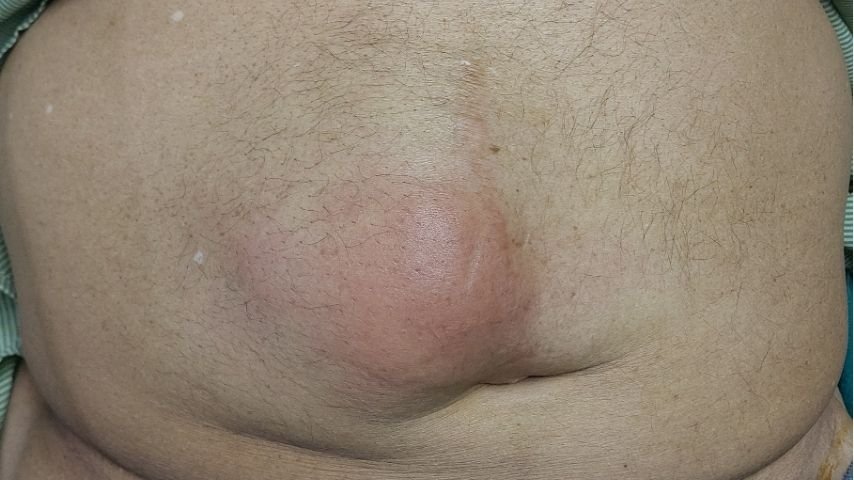
- The Skin Over the Lump Becomes Red, Purple or Dark
Changes in the skin over a hernia can be another warning sign.
If the lump becomes red, purple or unusually dark, particularly when accompanied by significant pain or tenderness, urgent medical assessment is needed.
This can happen when tissue becomes trapped and its blood supply is affected.
A strangulated hernia can become life-threatening if treatment is delayed.
Other concerning symptoms include fever, nausea, vomiting, abdominal swelling and difficulty passing stool or gas.
Do not wait for these symptoms to settle on their own.
Go to an emergency medical facility if you have a painful hernia with these warning signs.
What Does a Hernia Feel Like?
People describe hernia symptoms differently.
Some notice only a lump.
Others describe a feeling of pressure or heaviness.
Some feel a burning or aching sensation.
You may notice discomfort while exercising, lifting, coughing or standing.
Some people may also notice a gurgling sensation in the lump.
The location matters too.
An inguinal hernia usually appears in the groin. An umbilical hernia appears around the belly button. An incisional hernia may appear around a previous surgical scar.
A hiatal hernia is different. It occurs when part of the stomach moves upward through an opening in the diaphragm. It may not cause an external lump and can instead cause symptoms such as heartburn or acid reflux.
This is why the word “hernia” does not always mean the same type of problem.
How Does a Doctor Diagnose a Hernia?
The diagnosis often begins with a conversation.
Your doctor may ask when you first noticed the lump.
They may ask whether it becomes larger when you cough, strain or stand.
They may ask whether you have pain, constipation, chronic cough or a history of abdominal surgery.
The physical examination is also important.
The doctor may examine the area while you are standing and lying down. You may be asked to cough or strain because this can make the bulge easier to identify.
In many cases, a physical examination is enough.
If the diagnosis is uncertain, the doctor may recommend imaging.
An ultrasound can provide images using sound waves. A CT scan can provide detailed images of the abdomen. An MRI may also be used in selected cases.
The choice depends on the location of the suspected hernia and what the doctor needs to understand.
Suggested image: Illustration of a doctor examining a patient for an inguinal hernia while the patient stands and coughs.
Can a Hernia Go Away on Its Own?
This is a common question.
The answer depends on the type of hernia and the individual situation.
A hernia may appear to disappear when you lie down because the tissue moves back into the abdomen.
But this does not necessarily mean that the weak area has healed.
The underlying opening or weakness may still be present.
Some people with small, minimally symptomatic inguinal hernias may be advised to follow a watchful-waiting approach under medical supervision.
Others may need surgery, especially if the hernia is painful, enlarging or affecting daily activities.
The decision should be made with a doctor rather than based only on whether the lump is currently visible.
Can Exercise Make a Hernia Worse?
Exercise itself does not mean that you will definitely make a hernia worse.
However, activities that significantly increase pressure inside the abdomen may make the bulge or discomfort more noticeable.
Heavy lifting and repeated straining are common examples.
If an activity consistently causes pain or makes the lump more prominent, stop and discuss it with your doctor.
Do not assume that repeatedly “strengthening your core” will repair a hernia.
Exercise can be an important part of overall health, but it does not necessarily close the defect through which tissue is protruding.
Your doctor can advise you about activities that are appropriate for your particular condition.
When Does a Hernia Need Surgery?
Not every hernia requires emergency surgery.
Some people with few or no symptoms may be monitored.
However, a painful or progressively enlarging hernia is more likely to require surgical repair.
Surgery is also required urgently when a hernia becomes incarcerated or strangulated.
The purpose of hernia surgery is to return the protruding tissue to its appropriate position and repair or strengthen the weak area in the abdominal wall.
Depending on the type and location of the hernia, surgery may be performed through an open approach or through minimally invasive techniques such as laparoscopic surgery.
In some repairs, surgical mesh is used to reinforce the abdominal wall.
The best technique depends on the type of hernia, its size, your health, previous surgeries and other factors.
Your surgeon will explain the most appropriate option for you.
Suggested image: Simple comparison between open hernia surgery and laparoscopic keyhole hernia surgery.
What Happens If You Ignore a Hernia?
Some hernias may remain relatively stable for a period of time.
Others can gradually become larger or more uncomfortable.
The biggest concern is that the tissue can become trapped.
If the trapped tissue loses its blood supply, the situation becomes an emergency.
This is why a hernia that suddenly becomes very painful, firm, swollen or discoloured should not be ignored.
Even if there are no emergency symptoms, a growing or increasingly uncomfortable lump deserves a medical evaluation.
Getting assessed does not automatically mean you will need surgery immediately.
It simply means you know what the lump is and can make an informed decision about what to do next.
When Should You Seek Emergency Medical Help?
If you have a known or suspected hernia, seek urgent medical attention if the lump suddenly becomes much larger, becomes very painful or tender, can no longer be pushed back by a healthcare professional, becomes red, purple or dark, or is associated with fever, nausea, vomiting, severe abdominal pain, abdominal swelling or difficulty passing stool or gas.
These symptoms can indicate an incarcerated or strangulated hernia.
A strangulated hernia can be life-threatening.
Do not wait for the symptoms to improve on their own.
The Key Takeaway
Not every lump is a hernia.
But a new lump in the groin, abdomen, belly button or near a previous surgical scar should not be ignored.
A lump that becomes more noticeable when you cough, sneeze, lift or strain can be a sign of a hernia. Pain, pressure, burning or heaviness can also occur.
The more serious warning signs are different.
Sudden severe pain, a lump that becomes trapped, skin that turns red or dark, nausea, vomiting, fever or difficulty passing stool or gas can indicate a complication that needs urgent medical attention.
The safest approach is simple.
Do not try to diagnose the lump yourself.
Get it examined by a qualified healthcare professional.
If it is a hernia, understanding its type and severity can help you decide whether monitoring or treatment is appropriate.
If you have noticed a new, persistent or growing lump in your abdomen or groin, consult a general surgeon for an evaluation. Early assessment can help identify the cause and ensure that any warning signs are recognised before they become an emergency.
Call to Action
Noticed a lump in your abdomen or groin?
Book a consultation with a general surgeon to find out whether it could be a hernia and understand the right treatment option for you.
References and Sources