Is Laser Fistula Surgery Really Successful? What Patients Should Know About Healing, Failure and Recurrence Rates
Medicine Made Simple Summary
FiLaC, or Fistula-tract Laser Closure, is a minimally invasive, sphincter-preserving treatment used for selected anal fistulas. It uses a thin laser fibre inside the fistula tract to encourage the abnormal tunnel to close without deliberately cutting the anal sphincter. It can help many patients, but it is not a guaranteed cure. Research shows that healing rates vary between studies, and some patients experience persistent fistula, recurrence or need for another procedure. Understanding the type of fistula, previous treatments, surgical expertise and realistic success rates is important before choosing laser fistula surgery.
Is Laser Fistula Surgery Really Successful?
If your surgeon has recommended laser fistula surgery, you may have heard that it is a modern, minimally invasive treatment with a high success rate.
That can sound reassuring.
But it also raises an important question.
How successful is FiLaC really?
The honest answer is that FiLaC can successfully heal an anal fistula in many patients, but it does not work in everyone.
Studies have reported different healing rates. Some have reported rates around 65% to 70%, while more recent pooled research has found a lower overall healing rate.
This difference does not necessarily mean that one study is wrong.
Anal fistulas are not all the same. Some are simple. Others are complex. Some pass through the sphincter. Some have multiple branches. Some are recurrent after previous surgery.
The success of FiLaC depends on these factors, as well as how the procedure is performed and how patients are followed up.
A 2025 systematic review of 24 studies involving 1,503 patients found a pooled primary healing rate of 57.46%. It also reported recurrence in 18.48% of patients.
So, FiLaC can be successful, but it should not be presented as a guaranteed cure.
What Exactly Is FiLaC?
FiLaC stands for Fistula-tract Laser Closure.
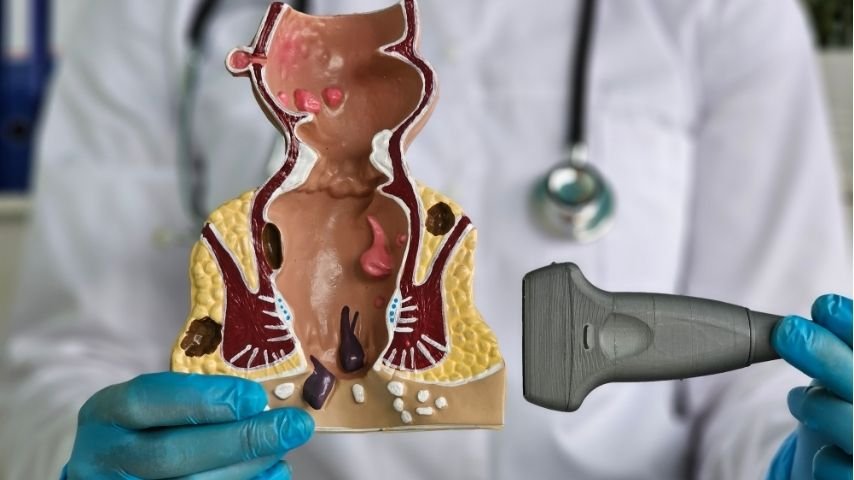
An anal fistula is an abnormal tunnel connecting the anal canal to the skin near the anus. It commonly develops after an abscess drains but leaves a tract behind.
During FiLaC, a thin laser fibre is placed inside this tract.
Controlled laser energy is then delivered along the tunnel.
The aim is to shrink and close the fistula from the inside.
One of the main advantages of the procedure is that it is designed to preserve the anal sphincter.
This matters because the sphincter muscles help control bowel movements.
A traditional fistulotomy involves opening the fistula tract and may involve cutting some sphincter muscle. It can be highly effective for appropriately selected simple fistulas, but may not be suitable when a significant amount of sphincter is involved.
FiLaC offers a different approach for selected patients.
Why Does Sphincter Preservation Matter?
The main concern with complex anal fistula surgery is not simply whether the fistula closes.
It is also whether bowel control is preserved.
If too much sphincter muscle is damaged, some patients may experience difficulty controlling gas or stool.
This is why surgeons may prefer sphincter-preserving techniques for fistulas that pass through a significant amount of muscle.
FiLaC is designed to treat the fistula tract without deliberately dividing the sphincter.
Research has generally reported low rates of new continence problems after FiLaC. A 2025 meta-analysis found new-onset incontinence in 0.57% of patients across the included studies.
However, preserving the sphincter does not guarantee that the fistula will heal.
This is the important balance patients need to understand.
What Do the Success Rates Actually Mean?
You may see a clinic website claiming a success rate of 70%, 80% or even higher.
Another article may quote a lower number.
Why are the figures different?
Because researchers do not always study the same patients.
One study may include mostly simple fistulas.
Another may focus on complex or recurrent fistulas.
Some studies may follow patients for six months.
Others may follow them for several years.
This matters because a fistula can appear healed initially and recur later.
Longer follow-up can therefore identify failures that shorter studies may miss.
A 10-year experience involving 175 patients treated with FiLaC found a primary healing rate of 66.8% at a median follow-up of 60 months. Twenty patients, or 11.4%, developed recurrence during follow-up.
In contrast, the more recent 2025 systematic review found a pooled primary healing rate of 57.46% and recurrence of 18.48%.
These figures provide a more realistic picture.
FiLaC can work well.
But recurrence remains possible.
What Is the Difference Between Healing and Recurrence?
These two terms can be confusing.
Healing means the fistula closes and symptoms resolve.
Recurrence means the fistula returns after it appeared to have healed.
A patient may initially have no discharge and no pain.
The external opening may close.
Everything appears normal.
Months later, the same area may begin draining again.
A lump may appear.
Pain may return.
This can indicate recurrence.
This is one reason long-term follow-up is important when assessing the success of fistula surgery.
A treatment that appears successful after three months may have a different long-term outcome.
What Does the Research Say About Recurrence?
The available research shows that recurrence after FiLaC is real.
In the 175-patient long-term study, 11.4% of patients experienced recurrence at a median of 18 months.
The 2025 meta-analysis found recurrence in 18.48% of patients.
Another 2025 network meta-analysis comparing several sphincter-sparing techniques reported a failure rate of 43.9% for FiLaC across the included studies, although the authors noted substantial variation between studies and concluded that more homogeneous long-term research is needed.
These numbers should not be interpreted as your personal probability of recurrence.
They represent results from groups of patients with different fistula characteristics and different treatment approaches.
Your surgeon can give you a more meaningful estimate based on your specific anatomy and history.
Why Does FiLaC Fail in Some Patients?
There is no single reason.
The fistula itself may be complex.
It may have multiple branches.
The internal opening may be difficult to identify.
There may be an undetected abscess.
The fistula may be long or have a difficult pathway.
Previous operations may have created scar tissue.
There may also be underlying conditions that affect healing.
If the fistula tract does not completely close, persistent drainage may continue.
The external opening may close temporarily and then reopen.
An abscess can also develop if fluid becomes trapped.
This is why careful assessment before surgery is so important.
Does a Seton Before FiLaC Improve Success?
A seton is sometimes placed before laser treatment.
It keeps the fistula draining and can help control infection and inflammation.
The purpose is not necessarily to cure the fistula immediately.
Instead, it can prepare the area for definitive treatment.
In the long-term study of 175 FiLaC patients, 142 had a seton or draining loop placed before laser treatment. Their primary healing rate was 70.4%, compared with 51.5% among those who did not have prior drainage.
This suggests that staged drainage may be helpful in selected patients.
However, it does not mean that everyone needs a seton before FiLaC.
The decision depends on whether there is infection, an abscess, significant inflammation or complex fistula anatomy.
Can FiLaC Work for Recurrent Fistulas?
Yes, it can be considered for selected recurrent fistulas.
In fact, sphincter preservation may be particularly attractive when a patient has already undergone previous surgery.
Repeated operations can create scar tissue.
Further cutting of the sphincter may increase concerns about bowel control.
FiLaC provides another way of approaching the fistula without deliberately dividing the sphincter.
However, recurrent fistulas can also be more difficult to treat.
The anatomy may have changed.
There may be additional branches.
The internal opening may be difficult to locate.
The surgeon needs to reassess the fistula rather than simply repeating the previous treatment.
What Happens If FiLaC Does Not Work?
Failure of FiLaC does not mean that there are no further options.
The next treatment depends on why the procedure failed.
Your surgeon may recommend repeat FiLaC in selected cases.
Other possibilities include:
- LIFT
- advancement flap
- VAAFT
- another sphincter-preserving procedure
Sometimes a seton may be placed again to control drainage before another definitive procedure.
In the long-term study of 175 patients, 26 patients underwent repeat FiLaC after the first procedure failed. Twelve of those patients healed after the repeat laser treatment.
This means that repeat laser treatment can work for some patients.
But it should not be assumed to be the best option for everyone.
The fistula should be reassessed before deciding what comes next.
Does FiLaC Have a Lower Risk of Incontinence?
One of the strongest reasons for considering FiLaC is its sphincter-preserving design.
Because the procedure is performed inside the fistula tract, it does not deliberately cut through the sphincter.
This can be particularly valuable for high or complex fistulas.
The 2025 meta-analysis found new-onset incontinence in only 0.57% of patients across the included studies.
Earlier research also reported low rates of continence problems. A systematic review of 454 patients reported a weighted mean continence-affection rate of about 1%, mainly involving minor soiling.
However, no procedure should be described as completely risk-free.
The risk to bowel control also depends on the fistula itself and previous operations.
Is FiLaC Better Than Fistulotomy?
Not necessarily.
These procedures are often used for different types of fistulas.
Fistulotomy can be extremely effective for appropriately selected simple fistulas.
A large retrospective series of 1,250 patients reported a 98.6% healing rate among patients treated with fistulotomy, with careful patient selection.
But this does not mean fistulotomy is the best procedure for every patient.
If a fistula passes through a significant portion of the sphincter, cutting through that muscle may carry unacceptable continence risks.
In those situations, a sphincter-preserving procedure such as FiLaC may be considered.
Therefore, comparing procedures only by their success percentages can be misleading.
The correct question is not, “Which procedure has the highest number?”
It is, “Which procedure provides the best balance of healing and sphincter protection for my fistula?”
What Makes Someone a Better Candidate for FiLaC?
FiLaC may be particularly relevant when the fistula is complex or transsphincteric and a traditional fistulotomy would risk significant sphincter injury.
It may also be considered in selected recurrent cases.
Patients who have already undergone previous fistula surgery may benefit from having a sphincter-preserving option available.
However, the fistula needs to be suitable for the technique.
An active abscess generally needs to be addressed first.
A fistula with multiple branches may require a different approach.
Underlying Crohn's disease can also change the treatment strategy.
This is why a specialist assessment is essential.
Does the Surgeon’s Experience Matter?
Yes.
FiLaC is not simply about placing a laser fibre and turning on the laser.
The surgeon must identify the fistula pathway accurately.
The internal opening needs to be understood.
The tract needs to be appropriately prepared.
The laser needs to be delivered in a controlled manner.
Patient selection is equally important.
A technically successful procedure may still fail if the fistula is unsuitable for the treatment.
When considering FiLaC, ask your surgeon how frequently they perform the procedure and what outcomes they see in patients with fistulas similar to yours.
Can MRI Help Predict Whether FiLaC Has Worked?
MRI can be useful in selected complex fistulas.
It can show whether the fistula tract has closed and whether there are residual branches or collections.
Research on complex high fistulas has found a strong relationship between radiological healing on postoperative MRI and long-term clinical healing. In one study, fistulas that had not healed radiologically all subsequently recurred, while most that showed radiological healing remained healed during follow-up.
However, not every patient needs routine postoperative MRI.
Your surgeon will decide based on the complexity of the fistula, symptoms and clinical examination.
What Questions Should You Ask Before Choosing FiLaC?
Before agreeing to laser fistula surgery, ask your surgeon:
- exactly what type of fistula you have
- whether it is simple or complex
- how much sphincter muscle is involved
- whether there are multiple branches
- whether an MRI is required
- whether you need a seton before FiLaC
- about the surgeon's own healing and recurrence results
- how long patients are followed after surgery
- what the next treatment would be if the fistula does not heal
These questions can give you a more realistic understanding of the procedure than a generic success-rate figure.
The Key Takeaway
FiLaC is a genuine treatment option for anal fistula, and it can successfully heal many patients.
But it is not a guaranteed cure.
Current evidence shows considerable variation in healing rates. The most recent systematic review found a pooled primary healing rate of 57.46%, while a long-term single-centre study reported 66.8%.
Recurrence is also possible.
The major advantage of FiLaC is its sphincter-preserving design.
For selected complex fistulas, this may provide an important balance between treating the disease and protecting bowel control.
The right candidate is not simply someone who wants laser surgery.
The right candidate is someone whose fistula anatomy makes the technique appropriate.
Conclusion
Laser fistula surgery has changed the way some anal fistulas can be treated.
FiLaC offers a minimally invasive approach that aims to close the fistula tract without deliberately cutting the sphincter.
That makes it an attractive option for selected patients, particularly those with complex or transsphincteric fistulas where preserving bowel control is important.
But patients should have realistic expectations.
A successful procedure is not guaranteed.
Research shows primary healing rates ranging from approximately 57% to 67% in major recent reviews and long-term studies, with recurrence occurring in a proportion of patients.
The difference between studies is a reminder that success depends on much more than the laser itself.
- Fistula anatomy matters.
- Previous surgery matters.
- Infection matters.
- Patient selection matters.
- The surgeon's experience matters.
- Long-term follow-up matters.
If FiLaC does not work, other treatments may still be available. Repeat laser treatment can work in selected patients, while LIFT, advancement flap, VAAFT, seton-based treatment or another approach may be considered depending on the situation.
If you are considering laser fistula surgery, do not choose it simply because it is marketed as a newer or less invasive procedure.
Ask whether it is appropriate for your fistula.
Understand the expected healing rate.
Ask about recurrence.
Ask about the possibility of needing another procedure.
And most importantly, understand how the treatment protects your sphincter.
The best fistula treatment is not necessarily the procedure with the highest advertised success rate.
It is the treatment that offers the most appropriate balance between healing the fistula, preventing recurrence and protecting long-term bowel control.
References and Sources
PubMed – Effectiveness of Laser-Based Fistula Therapies: Systematic Review and Meta-analysis, 2025
PubMed – Treatment of Anal Fistula With FiLaC: Results of a 10-Year Experience With 175 Patients
PubMed – A Systematic Review and Meta-analysis of the Safety and Efficacy of Fistula Laser Closure