The Tiny Camera Pill Explained: What Exactly is Capsule Endoscopy?
Medicine Made Simple
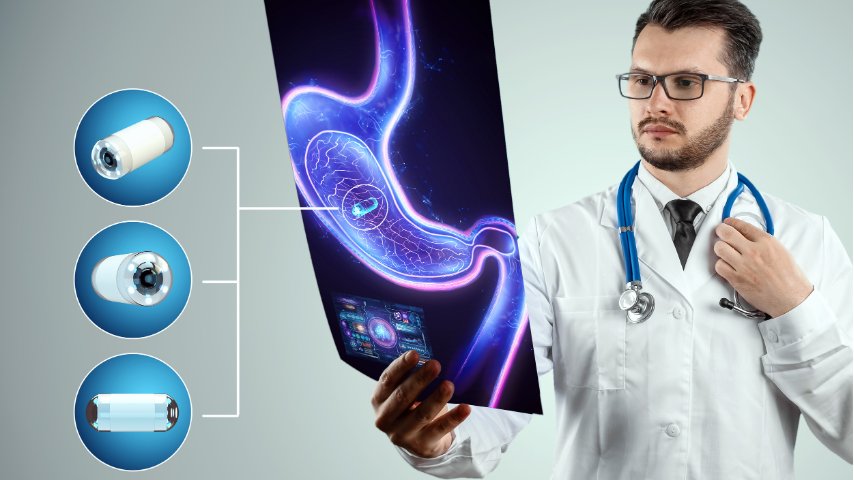
Capsule endoscopy is a simple, non-invasive procedure that allows doctors to examine the digestive tract using a tiny wireless camera inside a capsule about the size of a vitamin pill. After swallowing the capsule, it travels naturally through the digestive system while capturing thousands of images that are transmitted to a recorder worn on the body. The procedure is particularly useful for examining the small intestine, an area that is difficult to reach with traditional upper GI endoscopy or colonoscopy. It helps identify bleeding, inflammation, tumors, polyps, and other digestive conditions without surgery or sedation.
Introduction
Imagine being able to take a journey through your digestive system without a single incision, tube, or hospital stay.
It may sound like science fiction, but it is already a reality.
A tiny capsule, no larger than a vitamin pill, can travel through your digestive tract while taking thousands of detailed images. These images help doctors identify problems that may be difficult to detect using conventional tests.
This innovative procedure is called capsule endoscopy.
Over the last two decades, capsule endoscopy has transformed the way doctors investigate digestive disorders. It has made diagnosing conditions within the small intestine easier, safer, and more comfortable for patients.
If your doctor has recommended capsule endoscopy, or if you are simply curious about this remarkable technology, this guide will help you understand exactly what it is, how it works, why do I need an endoscopy, and what you can expect before, during, and after the procedure.
Understanding Your Digestive Tract
Before understanding capsule endoscopy, it helps to know a little about the digestive system.
The digestive tract is a long tube that starts at the mouth and ends at the rectum.
Food travels through several organs including the esophagus, stomach, small intestine, and large intestine.
Most people are familiar with procedures such as upper gastrointestinal endoscopy and colonoscopy.
An upper endoscopy allows doctors to look inside the esophagus, stomach, and upper part of the small intestine.
A colonoscopy examines the large intestine and rectum.
However, there is one area that has traditionally been difficult to examine.
That area is the small intestine.
The small intestine measures approximately six to seven meters in length. It lies deep within the abdomen and contains numerous loops and folds.
Because of its location and length, much of the small intestine cannot be easily reached using conventional endoscopy procedures.
This is where capsule endoscopy becomes extremely valuable.
What Exactly Is Capsule Endoscopy?
Capsule endoscopy is a diagnostic procedure that uses a miniature wireless camera enclosed within a swallowable capsule.
The capsule is about the size of a large vitamin tablet.
Inside this tiny capsule are several sophisticated components:
- A miniature camera.
- A light source.
- A battery.
- A wireless transmitter.
Once swallowed, the capsule moves naturally through the digestive tract.
As it travels, it continuously captures images of the digestive lining.
These images are transmitted wirelessly to a recorder that the patient wears around the waist or over the shoulder.
Over the course of several hours, the capsule captures thousands of images.
After the procedure, a gastroenterologist reviews these images carefully to identify abnormalities that may explain a patient's symptoms.
Why Was Capsule Endoscopy Developed?
For many years, diagnosing diseases within the small intestine was challenging.
Patients with symptoms such as unexplained bleeding, chronic abdominal pain, iron deficiency anemia, or suspected inflammatory bowel disease often underwent multiple tests without receiving a clear diagnosis.
Traditional imaging studies could sometimes miss small lesions hidden within the small intestine.
Doctors needed a better way to visualize this important part of the digestive tract.
Capsule endoscopy was developed to solve this problem.
The first capsule endoscopy systems became available in the early 2000s and quickly revolutionized gastrointestinal diagnostics.
Today, capsule endoscopy is considered one of the most important advancements in digestive medicine.
How Does the Tiny Camera Pill Work?
The process is surprisingly simple.
After swallowing the capsule with water, it begins its journey through the digestive system.
As it travels, tiny lights illuminate the digestive tract.
The built-in camera captures images multiple times every second.
These images are transmitted wirelessly to sensors attached to the patient's body and then stored on a recording device.
The capsule does not require any remote control.
It moves naturally using the same muscle contractions that normally push food through the digestive tract.
Once the battery runs out, the capsule continues moving until it is naturally passed in the stool.
Most patients never even notice when the capsule leaves their body.
Why Might Someone Need Capsule Endoscopy?
Doctors may recommend capsule endoscopy when they need a closer look at the small intestine.
One of the most common reasons is unexplained gastrointestinal bleeding.
Sometimes patients experience anemia or blood loss without an obvious source being found during endoscopy or colonoscopy.
Capsule endoscopy can help locate hidden bleeding within the small intestine.
Another common reason is suspected Crohn's disease.
Crohn's disease can affect any part of the digestive tract, including areas of the small intestine that are difficult to reach with traditional procedures.
Capsule endoscopy can identify inflammation, ulcers, and other signs of the disease.
Doctors may also use capsule endoscopy to evaluate tumors, polyps, celiac disease, and unexplained abdominal symptoms.
In some cases, it is recommended when previous scans or investigations have produced unclear results, prompting comparisons such as endoscopy vs CT scan.
Conditions That Capsule Endoscopy Can Help Detect
Capsule endoscopy may help identify a variety of digestive conditions.
These include small intestinal bleeding, Crohn's disease, celiac disease, tumors, polyps, ulcers, vascular malformations, and certain inherited conditions associated with gastrointestinal polyps.
It can also help evaluate areas of inflammation that might otherwise go unnoticed.
Because it provides detailed images of the small intestine, capsule endoscopy often fills important diagnostic gaps left by other tests.
Preparing for Capsule Endoscopy
Proper preparation is important because clear images depend on having an empty digestive tract.
Patients are usually asked to avoid eating or drinking for approximately 10 to 12 hours before the procedure.
Some doctors may recommend a bowel-cleansing preparation similar to what is used before a colonoscopy. You should carefully follow your doctor's instructions for endoscopy preparation.
The exact preparation depends on the reason for the examination and the doctor's recommendations.
Patients should always inform their healthcare team about any medications they are taking and any history of bowel obstruction, intestinal narrowing, or previous abdominal surgery.
What Happens on the Day of the Procedure?
One of the biggest advantages of capsule endoscopy is its simplicity.
Unlike many other procedures, sedation is usually not required.
When you arrive at the clinic, sensors may be attached to your abdomen.
These sensors connect to a small recording device worn around your waist.
You then swallow the capsule with water.
The process takes only a few moments.
Once the capsule is swallowed, you are generally free to leave the clinic and continue most normal daily activities.
Most people return to work, study, or routine household activities.
Strenuous exercise and heavy lifting are usually discouraged during the examination period.
What Does Swallowing the Capsule Feel Like?
This is one of the most common patient concerns.
Fortunately, most people find it surprisingly easy.
The capsule is slightly larger than a standard medication tablet, but its smooth surface makes swallowing straightforward.
For most patients, swallowing the capsule feels similar to taking a vitamin supplement.
Once swallowed, you cannot feel the capsule moving through your digestive tract.
There is typically no discomfort during the procedure.
Can You Eat and Drink During the Test?
In most cases, yes.
After the capsule has been swallowed, patients are usually allowed to drink clear liquids after approximately two hours.
Light meals may often be resumed after four hours.
Your doctor will provide specific instructions based on your individual situation.
Following these guidelines helps ensure that image quality remains high throughout the procedure.
What Happens After Capsule Endoscopy?
The recording phase typically lasts around eight hours.
After this period, the recording device is returned to the clinic.
The capsule itself does not need to be retrieved.
It is disposable and designed to pass naturally through the digestive tract.
Most capsules leave the body within 24 to 72 hours.
Patients often do not notice when this occurs.
The images collected during the procedure are then reviewed by a gastroenterologist.
Because thousands of images must be carefully examined, results may take several days to become available.
Capsule Endoscopy vs Traditional Endoscopy
Many patients wonder how capsule endoscopy compares with traditional endoscopy.
The two procedures serve different purposes.
Traditional endoscopy allows doctors to directly examine, biopsy, and sometimes treat abnormalities.
Capsule endoscopy focuses primarily on visualization.
Its greatest advantage is access to the small intestine.
Unlike traditional endoscopy, capsule endoscopy does not require sedation, recovery time, or insertion of long tubes through the mouth or rectum.
Patients can usually return to their normal routine immediately after swallowing the capsule.
However, if a suspicious abnormality is found, additional procedures may still be necessary for biopsy or treatment.
What Are the Benefits of Capsule Endoscopy?
Patients appreciate capsule endoscopy because it is comfortable and minimally invasive.
There are no tubes, injections, or sedation.
Recovery time is essentially nonexistent.
The procedure allows doctors to visualize parts of the small intestine that are difficult to examine using other methods.
This can lead to earlier diagnosis and more targeted treatment.
For many patients, capsule endoscopy provides answers that previous tests could not.
Are There Any Risks?
Capsule endoscopy is generally considered very safe.
The most important potential complication is capsule retention.
This occurs when the capsule becomes trapped in a narrowed area of the digestive tract.
Although uncommon, retention can occur in patients with severe inflammation, tumors, scar tissue, or intestinal strictures.
Doctors carefully assess risk factors before recommending the procedure.
In some cases, a dissolvable test capsule may be used beforehand to ensure that the digestive tract is open enough for the procedure.
Most patients complete capsule endoscopy without any complications.
Common Myths About Capsule Endoscopy
Some people worry that the capsule contains tracking devices or remains permanently inside the body.
Neither is true.
The capsule is designed specifically for medical imaging and is naturally eliminated after completing its journey.
Others believe that the procedure is painful.
In reality, most patients experience no discomfort at all.
Another misconception is that capsule endoscopy replaces all other digestive investigations.
While it is a powerful diagnostic tool, it complements rather than replaces procedures such as endoscopy and colonoscopy.
When Should You Talk to Your Doctor About Capsule Endoscopy?
You should discuss capsule endoscopy with your doctor if you have unexplained digestive symptoms that remain undiagnosed despite previous investigations.
Persistent anemia, unexplained gastrointestinal bleeding, suspected Crohn's disease, chronic abdominal pain, and certain inherited gastrointestinal conditions may warrant further evaluation using capsule endoscopy.
Your gastroenterologist can determine whether this procedure is appropriate for your situation.
Conclusion
Capsule endoscopy represents one of the most remarkable advances in modern digestive healthcare.
A tiny camera pill can now travel through the digestive tract, capturing thousands of detailed images and providing doctors with valuable information that was once difficult to obtain.
For patients, the procedure offers a comfortable, convenient, and highly effective way to investigate conditions affecting the small intestine.
By combining advanced technology with patient-friendly design, capsule endoscopy has made digestive diagnostics simpler, safer, and more accessible than ever before.
Call to Action
If you are experiencing unexplained digestive symptoms, ongoing anemia, suspected Crohn's disease, or gastrointestinal bleeding that remains undiagnosed, consult a gastroenterologist to find out whether capsule endoscopy may be the right investigation for you. Early diagnosis can make a significant difference in identifying the cause of your symptoms and helping you receive the appropriate treatment.